

Book an intro call

What a Custom Shopify Website Costs in 2026

Roughly $5,000 to $20,000 for a customised premium theme. About $20,000 to $70,000 for a custom Online Store 2.0 theme. Somewhere between $50,000 and $200,000 for a Shopify Plus build with integrations, and $80,000 to $250,000 or more for headless. Those are the bands agencies in the UK, EU and US commonly quote in 2026, and I am putting them first because that is what most people came here for.
The bands are wide on purpose. "A Shopify website" can mean a premium theme set up in a fortnight or a headless storefront with a custom backend and a team of eight, which is why five agencies can quote five numbers a factor of ten apart without any of them being dishonest. The rest of this article explains what sits inside each band, what you pay every month after launch, what moves a quote up or down, and how to brief agencies so their numbers are comparable. These are market ranges, not Teplin's price list.
The numbers at a glance
- Customised premium theme
Typically $5,000 to $20,000, over three to six weeks. - Custom Online Store 2.0 theme
Typically $20,000 to $70,000, over eight to fourteen weeks. - Shopify Plus build
Typically $50,000 to $200,000 or more, over three to six months. - Headless build
Typically $80,000 to $250,000 or more, over four to nine months. - Ongoing retainer
Typically $2,000 to $15,000 a month, depending on hours and seniority. - Shopify plan
From $29 a month (Basic, billed yearly) to $299 a month (Advanced, billed yearly), with Plus from $2,300 a month on a three-year term, as of October 2026.
Freelancers and offshore teams can come in lower, and senior agencies in London or New York can come in higher. Use the bands as a sense check rather than a quote.
The biggest cost driver is how much gets built for you
People often assume design quality sets the price. In my experience it rarely does. The number is driven by how much of the store has to be built specifically for you, how many other systems it has to talk to, and how much content and data has to be created or moved.
Two stores can look equally polished and differ in cost several times over. One has a single product type. The other has bundles, subscriptions, B2B pricing and an ERP behind it. Keep that in mind as you read the bands below.
A customised premium theme
This is a premium theme from the Shopify Theme Store adapted to your brand: colours, typography, a few custom sections, app setup and product import. Three to six weeks is a normal timeline.
I recommend this route to new brands, small catalogues and anyone who needs to sell quickly and learn before spending heavily. The trade-off is that you are working inside someone else's structure. Every significant deviation from the theme adds cost and can make future theme updates harder, so the discipline here is to change only what really matters.
A custom Online Store 2.0 theme
Online Store 2.0 is Shopify's theme architecture that lets merchants build pages from sections and blocks in the theme editor. A custom theme means a designer creates the full design system and page templates from scratch, and developers build a theme around it, usually with a library of reusable sections your team can arrange without code. Eight to fourteen weeks is typical.
Most established DTC brands end up here, and I think for good reason. You get a store that reflects the brand properly, loads fast because it carries no features you do not use, and lets your marketing team build landing pages without waiting for a developer. Most of our Shopify web design work sits in this band.
A Shopify Plus build
A Shopify Plus project usually combines a custom theme with work that only Plus allows or that larger businesses need. That includes checkout UI extensions on every checkout step, custom apps using Shopify Functions, B2B with company-specific catalogues, expansion stores and integrations with an ERP, PIM, 3PL or CRM. Expect three to six months.
The platform fee comes on top: Plus starts at $2,300 a month on a three-year term or $2,500 a month on a one-year term. Over a three-year term that fee alone adds up to more than many theme builds, so include it when you compare a Plus project with a standard-plan one.
A headless build
A headless build separates the storefront from Shopify's theme layer. The front end is a custom application, often built with Hydrogen, Shopify's React-based framework, while Shopify runs the backend, catalogue, checkout and orders. Headless gives full control over performance and experience, and it suits brands with complex content, app-like interactions or several front ends.
It is also the most expensive and demanding option. Multi-brand or highly custom builds can go well past the top of the band, build time is four to nine months, and you need developers permanently afterwards. I have written a separate piece on choosing between Hydrogen and Liquid for anyone seriously considering it.
Retainers after launch
Most brands keep an agency on a monthly retainer after launch, for improvements, new landing pages, CRO tests, app changes and seasonal campaigns. The market range runs from about $2,000 to $15,000 a month depending on hours and seniority.
My opinion is that a retainer is often better value than a big rebuild every three years. The store improves continuously instead of ageing between projects, and you never end up with a two-year backlog that justifies starting over.
The monthly bill once the store is live
After launch you pay a plan fee, payment processing, app subscriptions and, for most brands, some ongoing development. Many small and mid-sized brands spend somewhere between a few hundred and a few thousand dollars a month on plan and apps combined, before any agency retainer.
1. Shopify plan fees
As of October 2026, Shopify's pricing page lists the following in USD:
- Basic
$39 a month billed monthly or $29 a month billed yearly. - Grow
$105 a month billed monthly or $79 a month billed yearly. - Advanced
$399 a month billed monthly or $299 a month billed yearly. - Shopify Plus
From $2,300 a month on a three-year term or $2,500 a month on a one-year term.
2. Payment processing
Processing is charged on top. Published US online card rates through Shopify Payments run from 2.9% + 30¢ on Basic down to 2.25% + 30¢ on Plus, and rates differ by country. If you use a third-party gateway, Shopify adds a transaction fee of 2% on Basic, 1% on Grow, 0.6% on Advanced and 0.2% on Plus.
3. Theme licence
Shopify offers free themes, including the Horizon family of ten free themes released in May 2025 and built with theme blocks. Paid Theme Store themes are licensed to the store where they were bought, and Plus merchants need a separate licence for each storefront that uses the theme. Independent tracking of Theme Store prices in October 2026 put the median paid theme at about $300, with the most expensive popular themes around $500. A custom theme built by an agency has no licence fee, because you own it.
4. Apps
Apps are the cost that creeps. A typical DTC stack might include reviews, email and SMS, subscriptions, search and filtering, loyalty, returns and analytics. Small stores often spend $100 to $500 a month on apps, and growing brands commonly spend $500 to $3,000, mostly driven by email and SMS platforms that charge by contact count. Review the list every six months and remove whatever nobody uses. Unused apps cost money and can slow the store down.
5. Maintenance
Shopify handles hosting, security and platform updates, so there are no servers or patches to pay for. What you do pay for is change: campaign pages, app and theme updates, fixes after app conflicts and conversion work. Some brands buy a small monthly block of hours, others run a full retainer or hire an in-house developer.
What pushes a quote up
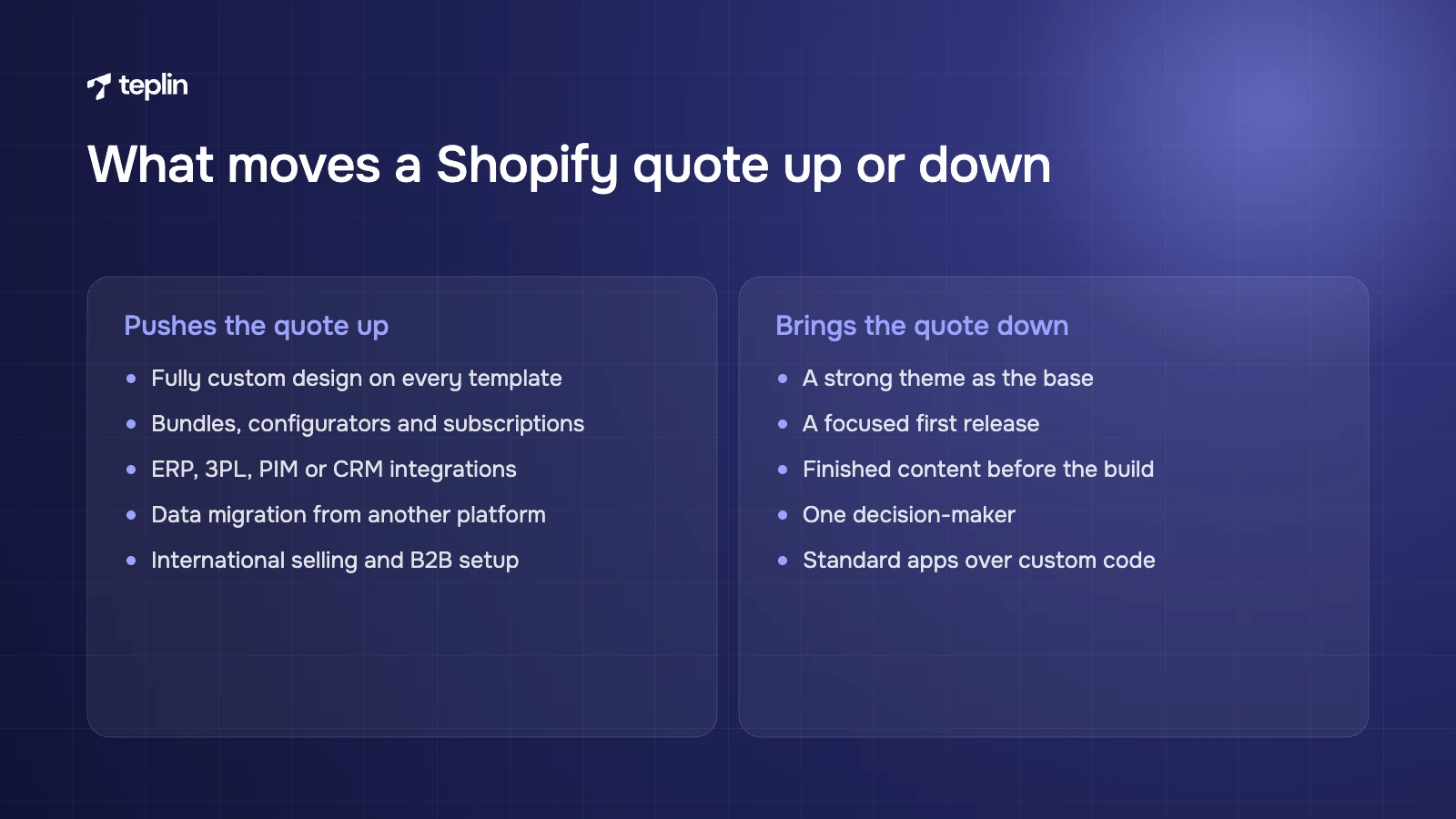
- Fully custom design
Designing every template from scratch, mobile included, takes far longer than adapting a theme. - Complex products
Bundles, configurators, personalisation, subscriptions and made-to-order products all need custom logic and careful testing. - Integrations
Connecting an ERP, 3PL, PIM or CRM is often the most underestimated part of a project, especially when the other system has a poor API. - Data migration
Moving products, customers, orders, reviews and URL redirects from another platform adds weeks of work and checking. - International selling
Several languages, currencies and region-specific content multiply design, content and testing time. - B2B and wholesale
Company accounts, price lists, payment terms and separate checkout flows need their own setup. - Content production
Copywriting, photography and video are usually separate budgets, and they often decide how good the store looks at launch.
What brings a quote down
- A strong theme as the base
Customising only what matters cuts design and development time. - A focused first release
Launching with the essentials and adding features later reduces risk and spreads the cost. - Finished content
Ready product copy, images and brand assets prevent delays and rework. - One decision-maker
A single person with clear authority keeps the project moving. Committees add weeks. - Standard apps over custom code
Well-supported apps for reviews, subscriptions or loyalty usually cost less than building those features.
Most budget overruns I have seen came from scope nobody wrote down, not from the platform.
Timelines and what makes them slip
The typical ranges are three to six weeks for a customised premium theme, eight to fourteen weeks for a custom theme, three to six months for Plus and four to nine months for headless. Faster is possible when scope is tight, content is ready and one person signs off.
Two of our own projects show what a focused launch looks like. THRSTY, a UK electrolyte brand, had its store built in 30 days with subscriptions and converts at 3.13%. Quantum Padel was designed and built in four weeks, also with subscriptions. Neither cut corners. Both moved fast because the brief was clear, the range was focused and decisions came quickly, and I would take that combination over a bigger team every time.
Timelines stretch when content arrives late, when an integration depends on another vendor, when stakeholders join halfway and when scope grows mid-build. If the date matters, protect it by agreeing what is in the first release and what waits for phase two.
A brief that gets you comparable quotes
Agencies price risk. Every unknown in your brief turns into a buffer in their estimate, so a clearer brief usually means tighter and lower quotes. You do not need a 40-page RFP. Two to five pages covering these points is enough:
- Business context
What you sell, where, your current revenue range and growth targets for the next 12 to 24 months. - Goals
The two or three outcomes that would make the project a success. - Current setup
Platform, theme, apps, traffic, conversion rate and the biggest problems your team and customers report. - Scope
Page types, product types and their logic, subscriptions, bundles, B2B, languages and currencies. - Integrations
Every system the store must connect to, with a note on who owns each. - Data and migration
What has to move and roughly how much of it. - Content
What you will supply and what the agency needs to create. - Budget range and timeline
An honest range, a target date, and which of the two is more fixed. - Decision process
Who decides, who gives feedback and how quickly you can review work. - What you want back
Phases, deliverables, team, timeline, exclusions, payment terms and post-launch support.
Sharing a budget range feels risky, but I would always do it. It lets an agency propose the right solution for the money instead of guessing, and it quickly filters out agencies that are the wrong size for you.
Share an honest budget range with every agency. It lets them propose the right solution for the money instead of guessing.
Reading two quotes side by side
When quotes arrive, resist comparing the totals first. Put them next to each other and compare what each one includes. One agency may have priced data migration, redirects and a post-launch warranty, while another has left all three out and will bill them later as extras. One may assume you supply all copy and photography, another may include it.
I suggest listing every deliverable from all the proposals in one document, then marking which quote covers which item. Gaps become obvious quickly. If two quotes still differ a lot once the scope matches, ask both agencies to explain their estimate for the largest line. The answers usually tell you more about how they work than the number does.
Choosing the agency
Look at relevant work, the people who will actually do the project, how they handle discovery and scope, and what happens after launch. Price matters, but the cheapest quote is rarely the cheapest project once rework and delays are counted.
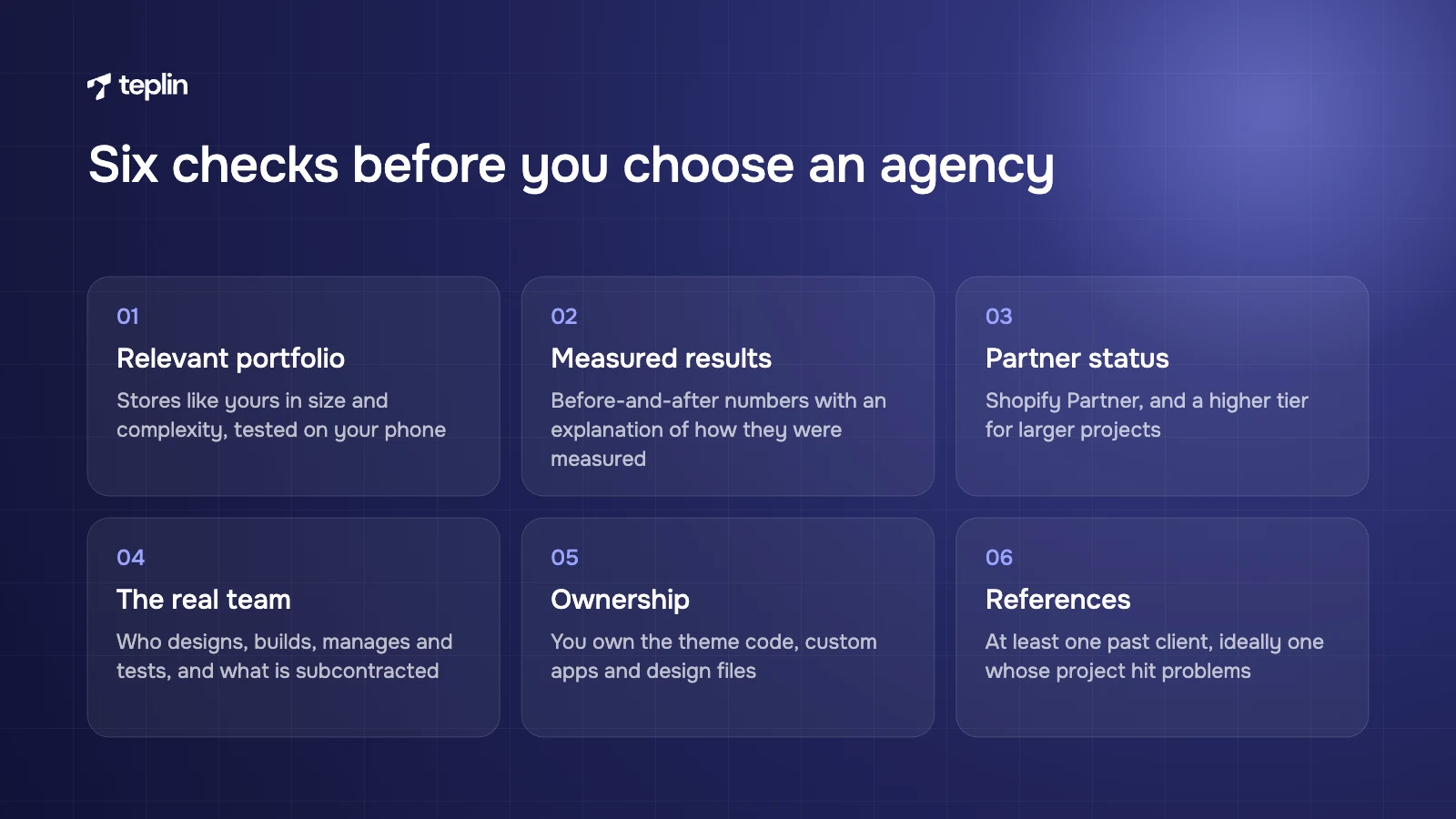
- Relevant portfolio
Stores similar to yours in size, product type and complexity. Open them on your phone and judge speed and usability yourself. - Measured results
Before-and-after numbers such as conversion rate, average order value or page speed, with an explanation of how they were measured. - Partner status
Whether the agency is a Shopify Partner and, for larger projects, whether it holds a higher partner tier. - The real team
Who will design, build, manage and test your project, and whether any of it is subcontracted. - Ownership
Confirmation that you will own the theme code, custom apps and design files, with repository access. - References
At least one past client, ideally one whose project hit problems, so you hear how they were handled.
Warning signs in a proposal
- A fixed price without questions
A detailed quote before any discovery usually means scope will be argued about later. - No exclusions listed
If the proposal does not say what is excluded, assume extras will be billed. - Timelines without phases
"Six to eight weeks" with no milestones or dependencies is a hope rather than a plan. - Twenty apps to fake custom features
Some apps are sensible. Too many slow the store and raise monthly costs. - Ownership held back
Refusing repository access or keeping the theme on the agency's partner account creates lock-in. - Guaranteed results
No honest agency can promise a specific conversion rate before seeing your traffic and product.
My view on paying for a custom theme
A custom theme is worth it when your brand, product logic or content needs have clearly outgrown what a premium theme can do, and when the revenue at stake justifies a five-figure investment. For a brand still testing product-market fit, a well-customised premium theme is usually the smarter first step, and I tell founders that even when it means a smaller project for us.
The return shows up in conversion and in team speed. A custom theme carries only the features you use, so it tends to load faster, and its sections are designed around your products rather than a generic demo store. The gains come from understanding the customer and the product, not from the theme itself, but a custom build gives you room to act on what you learn.
Frequently asked questions
How much does a basic Shopify store setup cost?
If you set it up yourself with a free theme, the main cost is the plan, from $29 a month billed yearly on Basic, plus apps. A professional setup with a premium theme, branding and product import commonly costs around $5,000 to $20,000 from agencies in the UK, EU and US. Freelancers can be cheaper for simple stores.
How much does a custom Shopify theme cost?
Agencies typically quote about $20,000 to $70,000 for a custom Online Store 2.0 theme, depending on the number of templates, custom features and integrations. Larger brands with complex requirements can pay more. You own the theme, so there is no licence fee.
How much do Shopify agencies charge per hour?
Rates vary widely by country and seniority. As a rough market guide, many established agencies in the UK, EU and US charge somewhere between $80 and $200 an hour, while offshore teams and freelancers can be considerably lower. Full builds are more often priced per project than per hour.
Do I need Shopify Plus for a custom website?
No. A fully custom theme runs on any Shopify plan. Plus becomes relevant when you need full checkout customisation, custom apps using Shopify Functions, unlimited B2B catalogues, expansion stores or the volume and support levels larger businesses need.
How fast can a Shopify store be launched?
A focused store can launch in about four weeks when content is ready and decisions are quick. Our THRSTY store was built in 30 days and Quantum Padel was designed and built in four weeks, both with subscriptions. Larger custom or Plus projects usually take several months.
Is headless Shopify worth it for a small brand?
Usually not. Headless builds cost significantly more to build and maintain and need developers permanently. Most small and mid-sized brands get better value from a fast, well-built Liquid theme and reinvest the difference in content, marketing and conversion work.
A realistic number for your store
The right budget matches your stage, your product complexity and your growth plans. If you want a straight answer on which band your project falls into, our Shopify web design team can scope it with you. Describe the store you have in mind, and I will come back with an honest range and the reasoning behind it.
Sources
- Shopify – Plans and pricing
- Shopify – Shopify Plus pricing
- Shopify Help Center – Theme licensing and unlicensed themes
- Shopify changelog – Horizon: 10 new free themes by Shopify
- Shopify.dev – Technologies for customising Shopify checkout
- Shopify.dev – Shopify Functions API availability
- Shop Theme Detector – Shopify theme pricing statistics (independent data, October 2026)
- Teplin – THRSTY case study
- Teplin – Quantum Padel case study

Get a free Shopify store audit

.webp)
Stay ahead of the curve

More from our resources
Is Shopify Plus Worth $2,300 a Month? Here Is the Real Bill



Ecommerce insights, straight to your inbox


10:33

10:33

16:33