

Book an intro call

Is Shopify Plus Worth $2,300 a Month? Here Is the Real Bill


$2,300 a month is the figure on Shopify's Plus pricing page, and it is the one everybody remembers. On most Plus budgets it is also one of the smaller lines. Card processing, apps, the build and the people who keep improving the store usually add up to far more over a three-year contract. I would rather founders saw the whole bill before they sign than discover it line by line in year two.
So this article starts with the money. You will find each cost on a Plus store set out in order, the maths on when Plus pays for itself against the Advanced plan, a worked three-year example, and only then the features you are actually paying for. At the end there is a list of situations where I tell brands to stay where they are, and a short set of questions to settle before you sign anything.
The short answer
Shopify Plus costs from $2,300 USD a month on a three-year term or $2,500 a month on a one-year term, according to Shopify's Plus pricing page in October 2026. Higher-volume businesses move to a variable platform fee that Shopify does not publish. On published US card rates, the lower processing fee only covers the higher licence against Advanced once a store takes roughly $800,000 to $880,000 a month through Shopify Payments. My honest take is that Plus is worth it when a Plus-only feature removes a real limit on revenue or operations, and when you have a team lined up to build with it. As a way to save on payments, it rarely adds up.
The licence fee is the first line on the bill
Shopify Plus starts at $2,300 USD per month on a three-year term and $2,500 USD per month on a one-year term. That fee covers your main store plus nine expansion stores. More complex or higher-volume businesses are moved to a variable platform fee based on revenue, and if your main payment processor is not Shopify Payments, Shopify adds 0.20% per transaction. Everything else, from apps to development, comes on top.
Here is where Plus sits against the standard plans in October 2026, in USD per month.
- Basic
$39 a month billed monthly or $29 a month billed yearly. - Grow
$105 a month billed monthly or $79 a month billed yearly. - Advanced
$399 a month billed monthly or $299 a month billed yearly. - Shopify Plus
From $2,300 a month on a three-year term or $2,500 a month on a one-year term.
Moving from Advanced to Plus multiplies the licence by roughly seven or eight. A jump that size deserves a spreadsheet, not a gut feeling.
One-year or three-year term
The three-year term saves $200 a month. That is $2,400 a year and $7,200 across the contract. In exchange you commit to Shopify for three years. If you are confident in the platform and in the shape of the business, take the saving. If a sale, a merger or a restructure is a realistic possibility, I would pay the small premium for the one-year term and keep the door open.
The variable platform fee nobody publishes
Shopify's pricing page says more complex, higher-volume businesses switch to a variable platform fee based on revenue and business model. It does not give the percentage or the threshold. Those terms come from the sales team.
For years the common understanding in the market was that the variable fee kicked in at around $800,000 of monthly sales, usually reported as 0.25% of sales with a monthly cap. Some independent reports in 2026 suggest the online rate has gone up since. I treat all of these figures as prompts for questions rather than facts. If your monthly revenue is anywhere near high six figures, ask Shopify to confirm in writing how the fee is calculated, which revenue counts (online, POS, B2B), whether a cap applies and how it is billed.
A 0.20% charge if you skip Shopify Payments
Use a processor other than Shopify Payments and you pay that processor's fees plus 0.20% per transaction to Shopify. Orders through Shopify Payments carry no such fee. The same surcharge is 0.6% on Advanced, 1% on Grow and 2% on Basic, so Plus has the lowest of any plan. It still adds up. A brand turning over $10 million a year on an external gateway pays Shopify $20,000 a year for the privilege, which is worth knowing before you pick a processor for other reasons.
Ten stores for one brand
The monthly fee includes the main store and nine expansion stores, ten in total. Each extra store costs $300 USD a month or a revenue share across all stores. Shopify's help centre presents expansion stores as a way to handle international selling and separate locations. One limit trips people up. Each Plus contract covers one brand, so a second brand needs its own contract and its own fee.
Plenty of international brands no longer need separate stores at all, because Shopify Markets handles currency, language, product availability and pricing inside one store. Expansion stores still make sense for a separate wholesale operation, very different regional catalogues or distinct legal entities.
Card processing is the line that moves the most money
Processing exists on every plan, so people tend to leave it out of the Plus decision. They shouldn't, because the rate difference is the only part of Plus that scales with revenue. Shopify's US pricing page lists these online card rates through Shopify Payments.
- Basic
2.9% + 30¢ per online card transaction. - Grow
2.7% + 30¢ per online card transaction. - Advanced
2.5% + 30¢ per online card transaction. - Shopify Plus
2.25% + 30¢ per online card transaction as the published US rate.
Rates differ by country, and the Plus page asks merchants to contact sales for current figures, so UK and EU stores should check the numbers for their own market. Larger Plus merchants can also negotiate. I use the published US rates below because they are the cleanest public numbers to work with.
Payment savings cover the fee only at very high volume
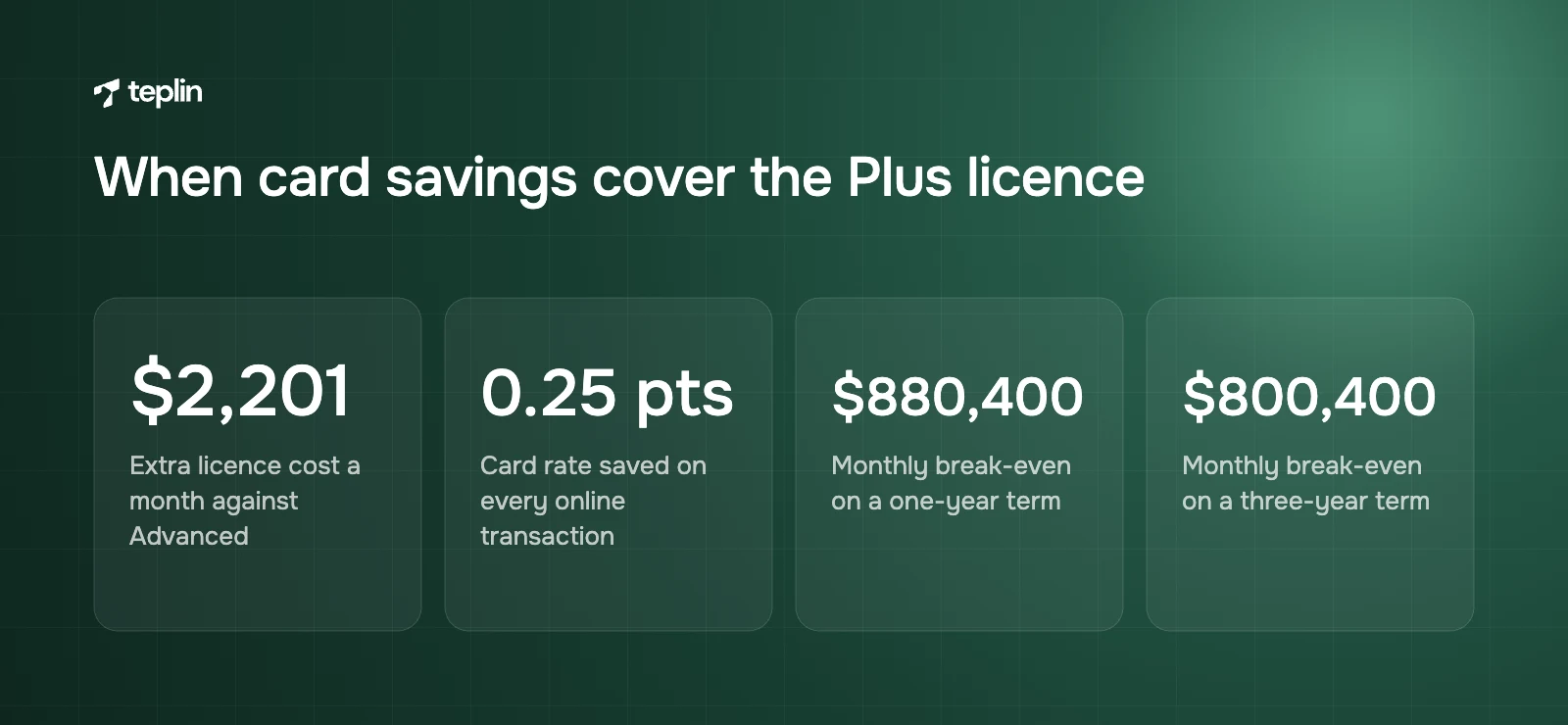
On processing alone, Plus breaks even against Advanced at roughly $800,000 to $880,000 of monthly card revenue through Shopify Payments, using published US rates. Below that, the lower card rate does not pay for the higher licence. That is why the question "is Shopify Plus worth it" nearly always comes down to features, apps and team time rather than payment savings.
The worked example
To keep it fair, I compare the cheapest realistic version of each plan, which is Advanced billed yearly at $299 a month against Plus on a one-year term at $2,500 a month.
- Licence difference
$2,500 minus $299 equals $2,201 more per month on Plus. - Card rate difference
2.5% minus 2.25% equals 0.25 percentage points saved on every online card transaction. The 30¢ fixed fee is identical on both plans, so it drops out. - Break-even revenue
$2,201 divided by 0.0025 equals $880,400 of monthly card revenue, or about $10.6 million a year. - On a three-year term
The gap becomes $2,300 minus $299, which is $2,001 a month. $2,001 divided by 0.0025 equals $800,400 a month, or about $9.6 million a year.
Put a smaller store through the same sum. At $300,000 a month in card sales, a 0.25-point saving is worth $750 a month against a licence gap of more than $2,000. And by the time card savings alone cover the fee, a business is close to the revenue level where the variable fee has historically applied. I think of payment savings as a pleasant side effect of Plus. They are not the business case.
The numbers with an external gateway
Brands that process through an external gateway see a slightly different picture. The Shopify surcharge falls from 0.6% on Advanced to 0.20% on Plus, a saving of 0.40 percentage points. $2,201 divided by 0.004 equals $550,250 of monthly revenue. So if you have strong reasons to stay with an outside processor, you reach break-even sooner. It is still a level most growing DTC brands have not reached.
Adding the apps you would genuinely remove
The version of this sum I find most useful also counts what Plus lets you stop paying for. Say Plus lets you replace $800 a month of apps with Shopify Functions and checkout extensions you own, and saves ten hours a month of manual work through Launchpad and better automation. At $50 an hour, that time is worth $500. The monthly gap shrinks from $2,201 to $901, and the break-even revenue on card savings drops to $360,400 a month.
Run this with your own figures, and be strict. Count only apps you would actually uninstall and hours you would actually get back. The most common mistake I see in these calculations is optimism about both.
A three-year bill for a hypothetical brand
Total cost of ownership on Plus is the licence plus processing, apps, the initial build or migration and ongoing development. For most mid-market DTC brands, the licence is a minority share of the three-year figure. The ranges below are typical market ranges quoted by agencies and vendors in the UK, EU and US. They are not our price list, and your own numbers will depend heavily on scope.
Licence
From $27,600 a year on a three-year term ($2,300 × 12) or $30,000 a year on a one-year term ($2,500 × 12), before any variable fee. Over three years the minimum is $82,800.
Processing
Usually the largest single line, even though you would pay it on any plan. At $5 million a year in online card sales on the published US Plus rate, the percentage part alone comes to $112,500 a year. A 0.1-point difference in a negotiated rate therefore moves more money than most app decisions do.
Apps
Mid-market Plus stores commonly spend somewhere between $500 and $3,000 a month on apps for reviews, subscriptions, search, loyalty, email and SMS, returns and analytics. Email and SMS tools that charge by contact count are often the biggest item. Plus will not replace most of these, and Shopify says as much. Custom Functions and checkout extensions can replace a handful of discount, bundling and checkout apps.
The build or migration
Agency quotes for a Plus build vary widely. As a broad market guide, a well-scoped move to Plus on a strong premium theme with custom sections often lands around $30,000 to $80,000. A fully custom design and theme with ERP, 3PL and subscription integrations typically runs from around $80,000 to $200,000 or more, and headless builds on Hydrogen sit higher again. Shopify itself does not charge to migrate, though it recommends budgeting for a Plus partner if you need custom development. Our breakdown of migration costs and why budgets overrun goes deeper on this line.
Ongoing development
A Plus store nobody improves after launch is an expensive way to stand still. Many brands keep an agency or in-house team on a monthly retainer for new features, CRO tests, app changes and seasonal campaigns. Market retainers for this work commonly range from around $2,000 to $15,000 a month depending on hours and seniority, with Plus stores usually in the middle or upper part of that range.
Adding it up
Take a hypothetical brand turning over $8 million a year online, on a three-year Plus term, with $1,500 a month of apps, a $60,000 build and a $5,000 monthly retainer. Over three years that comes to $82,800 in licence fees, $54,000 in apps, $60,000 for the build and $180,000 in retainer. The total is $376,800 before processing, and the licence is about 22% of it. This is why I push founders to judge Plus on what the whole package lets them achieve rather than on the licence alone.
The features you are actually paying for
The list of Plus-only features has changed a lot in three years, and several former exclusives are now on every plan. This is what Shopify's documentation says in October 2026.
Checkout customisation on every step
Checkout UI extensions for the information, shipping and payment steps are available only on Plus. So is the Checkout Branding API, which controls the look of checkout in depth. Shopify's plan comparison lists checkout customisation as "Limited" on Basic, Grow and Advanced and "Full" on Plus.
The detail matters. Checkout UI extensions on the Thank you and Order status pages work on every plan except Shopify Starter, as do web pixel extensions for tracking. A non-Plus store can add post-purchase upsells or surveys. It cannot add custom fields, banners or logic inside the checkout steps themselves.
Custom apps with Shopify Functions
Shopify Functions let developers write custom backend logic for discounts, shipping, payment methods, cart validation and more. Any plan can use public App Store apps that contain Functions. Only Plus stores can use custom apps that contain Function APIs. On Advanced you rent logic built for a common case. On Plus you can build logic for your exact pricing, bundling or shipping rules and own it.
Shopify Scripts are no longer a reason
For years, Scripts were one of the headline reasons to move to Plus. That reason has gone. Shopify stopped Scripts from being edited or published on 15 April 2026, and every Script stopped running on 30 June 2026. Plus customisation now means Functions for backend logic and checkout UI extensions for the interface. If you are inheriting a store that relied on Script-based discounts, our piece on what to do now Shopify Scripts have stopped running walks through the replacement.
B2B with unlimited catalogues
B2B is no longer Plus-only. Basic, Grow and Advanced include companies and locations, quantity rules and price breaks, net terms, vaulted cards, draft orders, quick order lists and the Trade theme, with up to three active B2B catalogues. Advanced adds contextual checkout and storefront. Plus adds unlimited catalogues, catalogues assigned to specific companies or company locations, deposits, partial payments and payment requests per fulfilment. On non-Plus plans, catalogue features require the new Shopify Markets. If wholesale is a large share of revenue and each account has its own price list, Plus is usually necessary. Our guide to B2B on every Shopify plan covers the split in detail.
Launchpad for drops and sales
Launchpad is Plus-only. It schedules and runs sales, product drops and restocks, can change prices automatically when an event starts and ends, and shows a live dashboard. Brands that run frequent drops get real value from it, mostly in fewer late-night manual changes and fewer mistakes.
Plus raises the limits on staff and APIs
Plus includes unlimited staff accounts (Advanced has 15), up to 200 inventory locations (other plans have 10), up to 25 Hydrogen headless storefronts (other plans have one), up to 10x API rate limits on select APIs, unlimited staging stores, up to 100 themes and 1 TB of file storage. Some API resources such as Multipass and the gift card APIs are Plus-only. Shopify's Plus pricing page also lists priority 24/7 support, Shopify Audiences and ShopifyQL Notebooks.
Features that no longer need Plus
Several features people still associate with Plus are now available more widely. Shopify Flow is a free app on Basic, Grow, Advanced and Plus. Public apps that use Functions run on every plan except Starter. Shopify Markets is available across plans, with market-specific checkout overrides on Advanced and Plus. I keep this list handy because it stops brands upgrading for things they already have.
Is Shopify Plus worth it for your store?
Plus is worth it when a specific Plus feature removes a real constraint, such as custom checkout logic, customer-specific wholesale pricing, several stores or high-volume launches, and when the brand has the budget to use that feature properly. I don't think it is worth it as a status upgrade, or when the biggest problems on the store are design, speed or product page conversion.
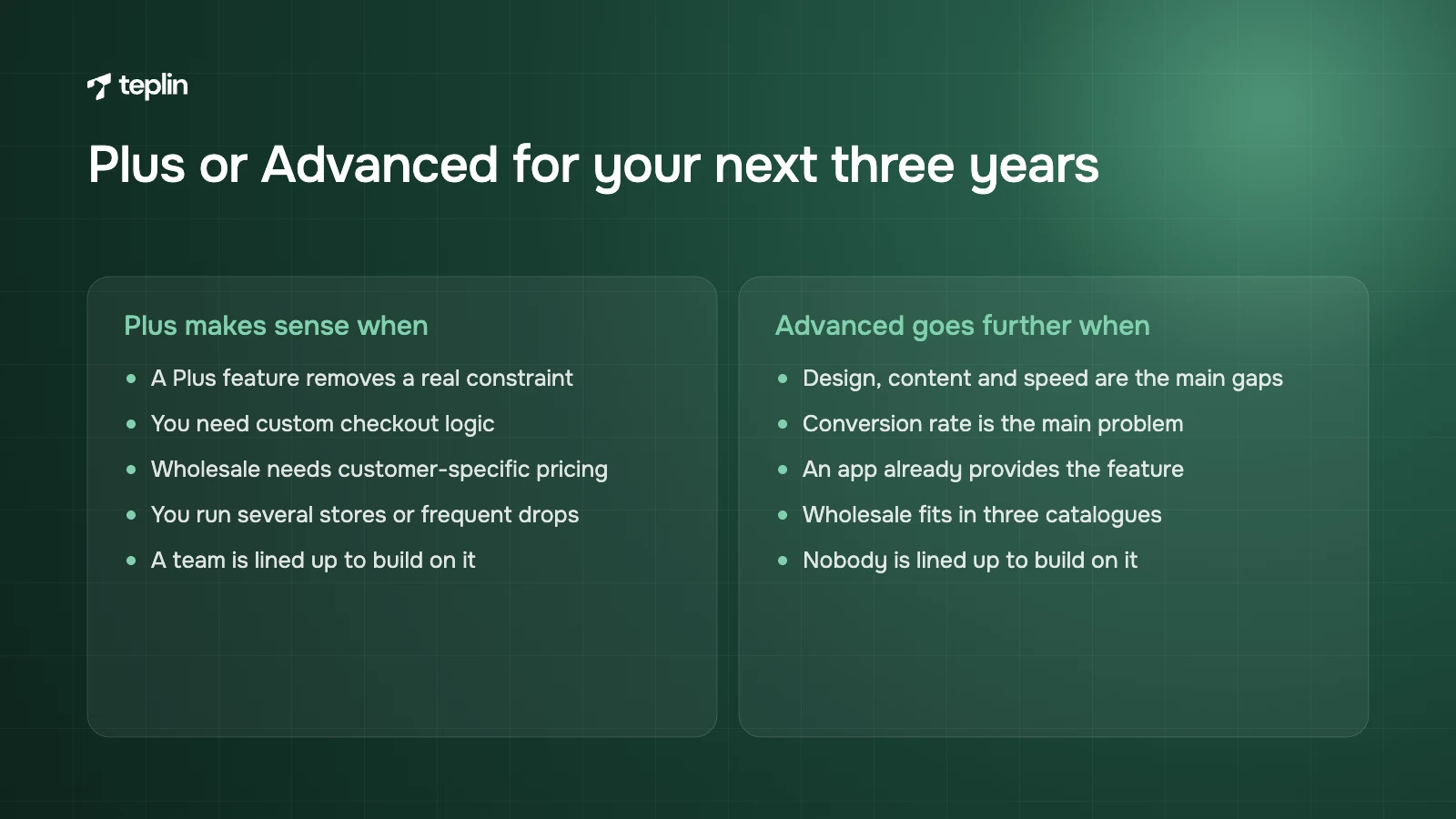
Advanced is the right plan for many brands turning over a few million a year. It gives lower card rates than Grow, 15 staff accounts, third-party calculated shipping rates, up to 2x API limits on select APIs and B2B with contextual checkout. It cannot give you full checkout control, custom Function apps, unlimited B2B catalogues, Launchpad or expansion stores.
One store we built on Plus is Nordik Recovery, a Canadian ice bath brand. On a product priced around $1,700 it converted at 1.15% and took more than 500 orders in its first month.
The five-things test
Here is a quick test I use with founders. Write down the five things your team most wants to change on the store in the next twelve months. If most of them sit in checkout logic, wholesale pricing, multiple stores or custom discounts, Plus is probably right. If most are about design, content and speed, Advanced with a good build will take you further for less money.
When I tell brands to stay on Advanced
We advise brands against upgrading fairly often. These are the situations where Plus is usually the wrong call.
- Revenue is under a few million a year and growing slowly
The $2,000-plus monthly difference is better spent on design, content, paid acquisition or CRO. - Conversion rate is the main problem
Plus does not fix weak product pages, slow load times or muddled messaging. A strong build on Advanced will move conversion more than a checkout banner ever will. - You want one Plus feature that an app already provides
Many Function-based discount and shipping apps in the App Store work on all plans. Check before you upgrade. - Nobody is lined up to build on it
Checkout extensions and custom Functions need developers. Without a partner or an in-house team, you pay for capability you never use. - Your wholesale needs fit in three catalogues
Non-Plus B2B now covers a lot. With a handful of price lists, Advanced may be enough. - You run several brands with modest revenue each
Every brand needs its own Plus contract, so the fee multiplies quickly. - The next three years are uncertain
If the business might be sold, restructured or moved to another platform, avoid locking into a three-year term.
Questions to settle before you sign
- Which Plus features will you use in year one?
Name each feature and the problem it solves, for example custom shipping logic or company-specific catalogues. - Does the break-even maths work with your own rates?
Use your real card mix, country rates, gateway and order volume rather than the US example above. - Which apps would you really remove?
Mark the apps Plus would replace and the ones that stay regardless. Count only genuine removals. - Do you have the variable fee terms in writing?
Confirm the threshold, rate, revenue definition, cap and billing schedule. - Is the term length a deliberate choice?
Pick three years only if you are confident in the platform and the business plan. - Is the build budgeted alongside year one of development?
Get two or three agency proposals with a clear scope, timeline and list of exclusions. - Is the checkout and Functions work mapped?
Map any old Scripts, checkout apps and tracking to Functions, checkout UI extensions and web pixels before launch. - Who owns the platform after launch?
Agree a retainer or an internal owner so the investment keeps paying back.
Frequently asked questions
What is the minimum price of Shopify Plus?
The lowest published price is $2,300 USD per month on a three-year term. On a one-year term it starts at $2,500 USD per month. Businesses with high revenue or complex structures may be moved to a variable platform fee instead.
What is the Shopify Plus variable platform fee?
It is a revenue-based fee that replaces the flat monthly licence for larger or more complex businesses. Shopify does not publish the rate or threshold on its pricing page. It has commonly been reported to start at around $800,000 in monthly sales, but confirm the exact terms with Shopify before signing.
Is Shopify Plus cheaper on payment processing?
Yes. The published US online card rate is 2.25% + 30¢ on Plus against 2.5% + 30¢ on Advanced, and the third-party gateway surcharge is 0.20% against 0.6%. In the US example above, the card saving only covers the higher licence at roughly $800,000 to $880,000 a month in card revenue.
Can I use Shopify Functions without Plus?
Partly. Every plan except Starter can use public App Store apps that contain Functions. Only Plus stores can use custom apps that contain Function APIs, which is what you need for logic built around your own business rules.
How many stores come with Shopify Plus?
The monthly fee includes the main store and nine expansion stores, ten in total. Extra stores cost $300 USD per month each or a revenue share. Each contract covers one brand, so a second brand needs its own contract.
If you want a second opinion on these numbers with your real card mix, app list and roadmap, that is a normal first conversation for our Shopify Plus development team. Send me the rough figures through our contact page and we will tell you plainly whether the upgrade makes sense yet.
Sources
- Shopify – Shopify Plus pricing
- Shopify – Plans and pricing
- Shopify Help Center – Shopify Plus plan
- Shopify.dev – Technologies for customising Shopify checkout
- Shopify.dev – Checkout UI extensions
- Shopify.dev – Shopify Functions API availability
- Shopify.dev changelog – Shopify Scripts will be deprecated on 30 June 2026
- Shopify changelog – Shopify Scripts can no longer be edited or published
- Shopify Help Center – B2B features by plan
- Shopify Help Center – Launchpad
- Shopify Help Center – Shopify Flow
- Shopify Help Center – Upgrading to Checkout Extensibility
- Teplin – Nordik Recovery case study

Get a free Shopify store audit

.webp)
Stay ahead of the curve

More from our resources
Is Shopify Plus Worth $2,300 a Month? Here Is the Real Bill



Ecommerce insights, straight to your inbox


10:33

10:33

16:33