

Book an intro call

Shopify vs WooCommerce for a Growing DTC Brand

I run a Shopify agency, so you should read what follows knowing which side I earn my living on. I will try to earn your trust anyway by being specific about the cases where I would tell a brand to stay on WooCommerce. This piece is for brands that already sell and feel the platform starting to push back, whether that is slow pages during a launch, a plugin update that broke checkout or a monthly bill that keeps creeping up.
The short answer
For a product-led DTC brand that wants to spend its time on marketing and product rather than servers, Shopify is usually the better fit, and the gap widens as you grow. WooCommerce stays the better choice when content is the business, when you need to own the whole stack, or when you already have strong WordPress developers in-house. Most decisions come down to four questions: where your money goes, what your payments look like, who maintains the store and how much of your revenue comes from editorial content.
It depends on where your money actually goes
Shopify costs more in subscription fees and less in maintenance. WooCommerce costs less in licences and more in hosting, developer hours and risk. For a brand with real revenue, the licence is the smallest line on both bills.
Shopify plans
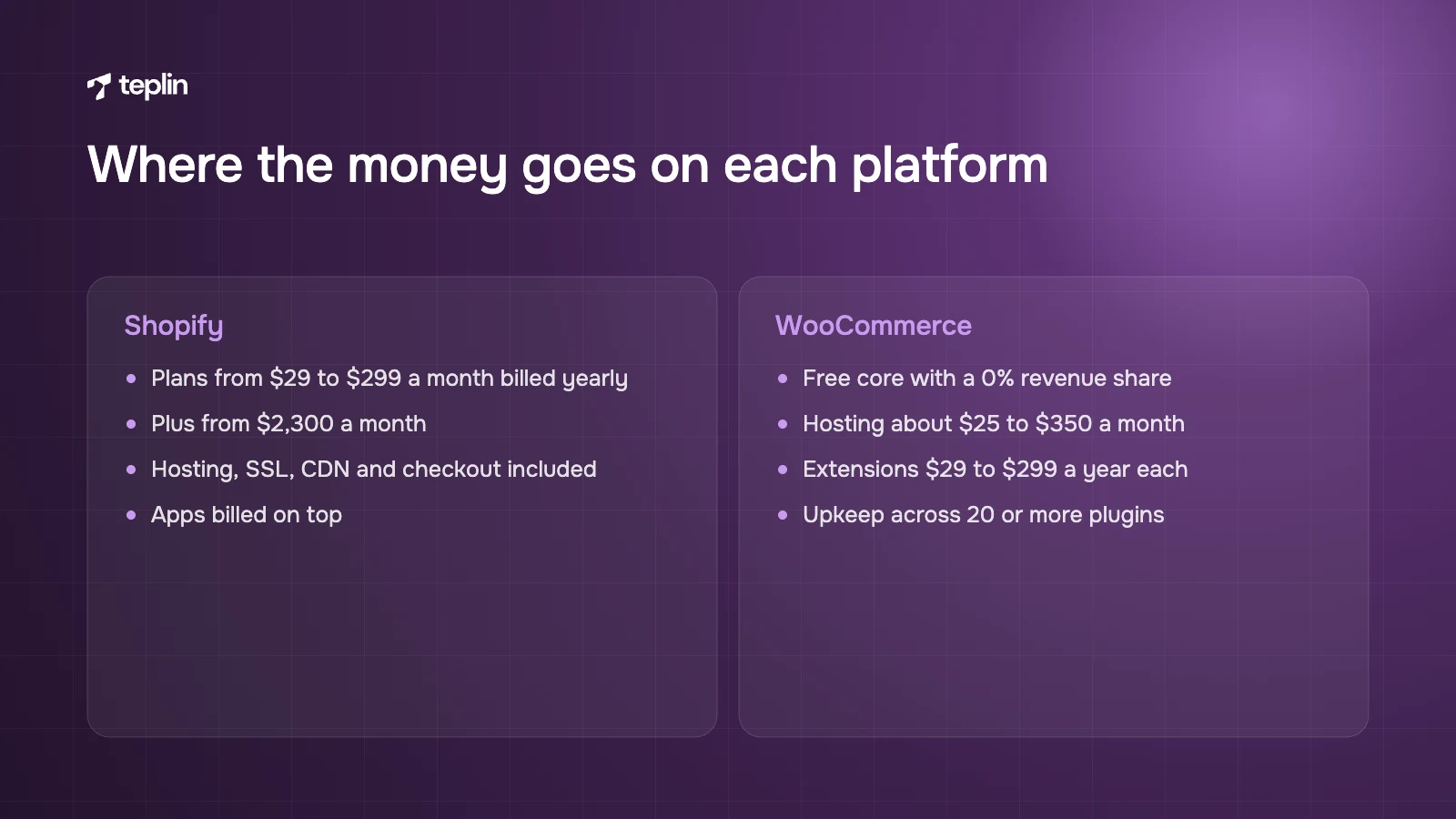
Shopify's published US pricing in October 2026:
- Basic
$29 a month billed annually or $39 monthly. - Grow
$79 a month billed annually or $105 monthly. - Advanced
$299 a month billed annually or $399 monthly. - Shopify Plus
From $2,300 a month on a three-year term or $2,500 on a one-year term, with larger businesses moving to a variable platform fee.
Hosting, SSL, a CDN and PCI-compliant checkout are included. On top you pay for apps such as reviews, email and SMS, search and subscriptions. Many bill monthly, so I tell clients to audit them once a year.
WooCommerce hosting and upkeep
WooCommerce describes its core as free, with no monthly subscription and a 0% revenue share. Its own pricing page then lists what takes the place of a Shopify plan: hosting at about $25–$350 a month for most stores and extensions at $29–$299 a year each. WooCommerce Subscriptions alone is $279 a year.
The line most comparisons skip is upkeep. A WooCommerce store is WordPress, a theme, WooCommerce and often 20 or more plugins, all updating on their own schedules. Someone has to test updates, roll back conflicts, patch security issues and keep backups. Agencies in the UK and US typically quote anywhere from a few hundred to a few thousand dollars a month for that kind of maintenance plan, depending on complexity and response times.
It depends on how you take payments
Shopify charges no transaction fee with Shopify Payments, which is available in more than 40 countries including the US, UK, Canada and most of the EU. US online card rates are 2.9% + 30¢ on Basic, 2.7% + 30¢ on Grow, 2.5% + 30¢ on Advanced and 2.25% + 30¢ on Plus, and rates vary by country. If a third-party gateway is your primary provider, Shopify adds 2%, 1%, 0.6% or 0.2% depending on plan. PayPal is exempt from that fee when Shopify Payments is primary.
At scale this is real money. A brand processing $1 million a year through a third-party gateway pays Shopify $10,000 a year on top of processor fees on Grow, $6,000 on Advanced and $2,000 on Plus. If you are tied to a specific processor for contractual or regional reasons, put that number in your model before anything else.
WooCommerce never takes a cut. You can use Stripe, PayPal, Adyen, Mollie or regional providers and negotiate directly as volume grows. WooPayments has no setup or monthly fee, with US card payments quoted at roughly 2.5–2.9% + 30¢ and a base rate of 1.5% + €0.25 in most European countries, plus 2% for non-European cards and 2% for currency conversion.
It depends on who will look after the store
This is the question I think matters most and gets asked least. On Shopify, hosting, security patches and checkout uptime are Shopify's job. Traffic spikes from a product drop or Black Friday are absorbed by its infrastructure, and checkout runs on its servers rather than yours. When a Shopify store is slow, the cause is almost always the theme and apps, which are fixable. That is the bulk of our speed and performance work.
On Shopify, hosting, security patches and checkout uptime are Shopify's job. On WooCommerce, every one of them is yours.
WooCommerce can scale well, but performance depends on your host, caching, database and plugin count. Its foundations have improved. High-Performance Order Storage, which moves orders into dedicated tables, has been the default for new installations since WooCommerce 8.2. A busy store still needs managed hosting, object caching and a CDN, and someone who understands all three.
A few feature differences sit inside this question too:
- Checkout
Shopify's hosted checkout is fast and familiar to shoppers, with Shop Pay for returning customers. You customise it through checkout extensibility and apps rather than editing it freely. WooCommerce lets you change anything, which suits unusual flows but makes every change yours to maintain. - Subscriptions
Shopify's own Shopify Subscriptions app is free, and established third-party apps add bundles, build-a-box and loyalty logic. On WooCommerce the paid Subscriptions extension is the standard route. Both work. For subscription brands we have built, such as Ovrload, the bigger gains came from the offer and the product page rather than the platform. - B2B
Shopify includes native B2B features on Basic, Grow, Advanced and Plus, such as company accounts, price breaks and net terms, with the fullest set on Plus. WooCommerce handles B2B through extensions, which is flexible but means combining several plugins. - Catalogue size
Since October 2025 every Shopify plan supports up to 2,048 variants per product, replacing the old 100-variant cap.
It depends on how much of your growth comes from content
This is where WordPress genuinely wins. You can set any URL structure, control sitemaps and robots rules freely and choose from mature SEO plugins. Shopify uses fixed paths such as /products/ and /collections/ that cannot be changed or redirected, and its blog editor is basic next to the WordPress block editor. If growth comes from a large editorial operation with several writers, custom content types and editorial workflows, WordPress is the better publishing tool.
For most product-led DTC brands, rankings depend far more on content quality, speed and internal linking than on URL patterns. Shopify's built-in sitemaps, canonical tags and CSV redirect imports cover what most stores need. Brands that want both can run Shopify for the store and WordPress or a headless CMS for editorial, with shared navigation.
Four situations where I would stay on WooCommerce
- Content is the business
A publisher or content-led brand where the shop is secondary to the editorial site. - You need full ownership of the stack
You want to self-host, keep data on your own servers or avoid depending on one company's pricing decisions. - Your products sit outside Shopify's policies
Some regulated categories face restrictions on Shopify or Shopify Payments. - You already have strong WordPress developers
An in-house team that knows the codebase removes most of the maintenance risk.
Lock-in cuts both ways. On Shopify you rent the platform and accept its rules, though products, customers and orders can be exported. On WooCommerce you own the code and every problem in it, and plugin vendors can change their pricing whenever they like.
Moving from WooCommerce to Shopify takes planning
A standard DTC migration usually takes several weeks, and longer with subscriptions, custom functionality or a redesign. The stages we follow:
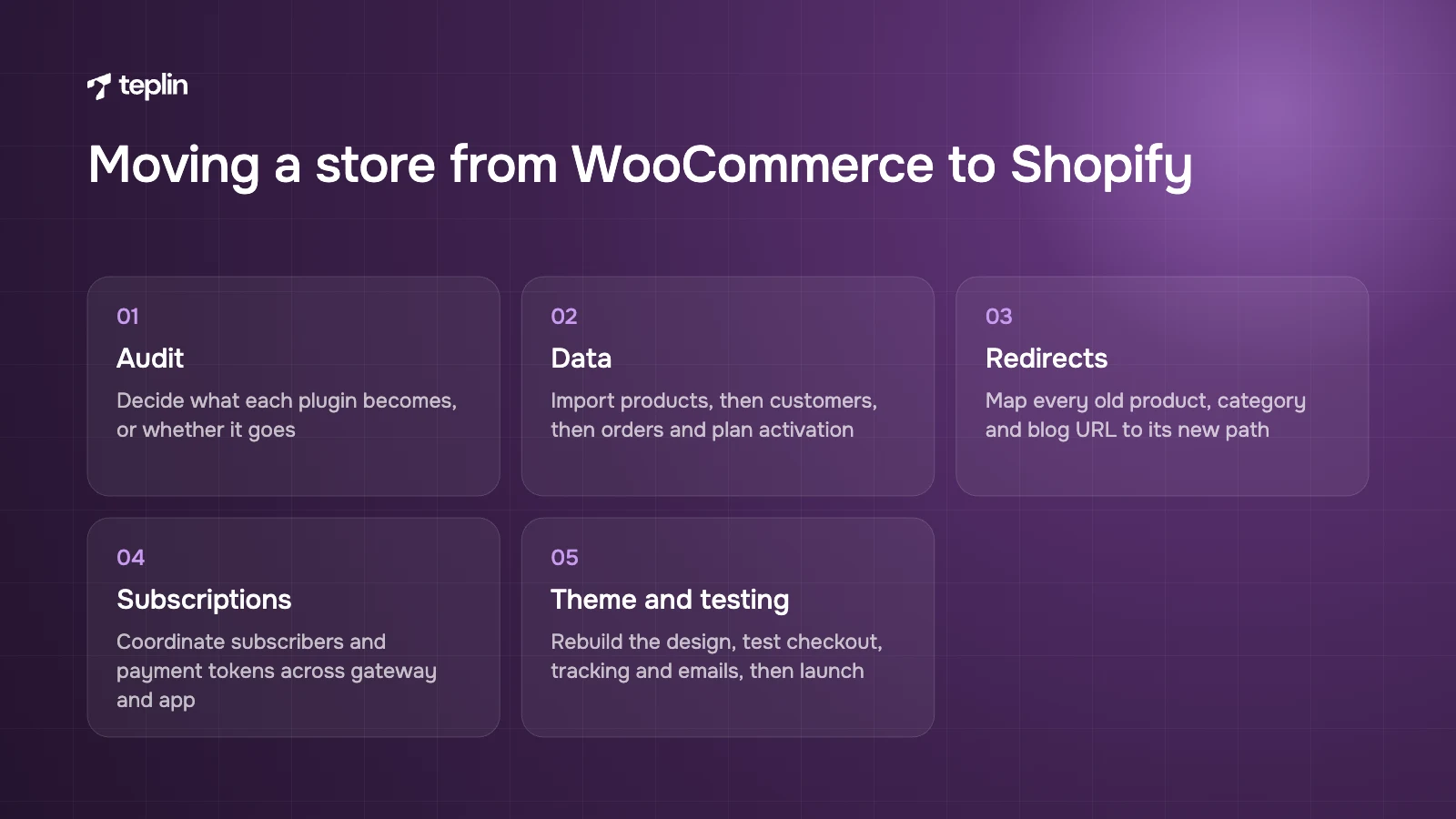
- Audit
List every plugin and decide whether it becomes a Shopify app, a native feature, custom development or nothing. - Data
Shopify recommends importing products first, then customers, then historical orders. Customer passwords generally cannot be carried across, so plan an account activation email. - Redirects
Map every old product, category and blog URL to its new path and import the redirects. Nothing protects rankings more. - Subscriptions
Moving active subscribers and payment tokens needs coordination between the old gateway, the new app and sometimes the processor. - Theme and testing
Rebuild the design, test checkout, tracking and emails, then launch with monitoring in place.
For budgets and timelines, see how much a Shopify migration costs and how long it takes. I would also treat a move as a chance to fix the experience rather than copy it. After we moved Bonz to Shopify with a redesign, conversion rose 33% and average order value 21%.
Frequently asked questions
Is Shopify more expensive than WooCommerce?
On subscription fees, yes. On total cost, often not. WooCommerce's free core is offset by hosting, paid extensions and the developer time a busy store needs, while Shopify includes hosting, security and checkout uptime in the plan.
Does Shopify charge transaction fees?
Not with Shopify Payments. With a third-party gateway as your primary provider, Shopify adds 2% on Basic, 1% on Grow, 0.6% on Advanced and 0.2% on Plus, on top of processor fees (October 2026).
Is WooCommerce better for SEO than Shopify?
WooCommerce offers more technical control and WordPress is a stronger blogging tool. For most product-led stores both can rank equally well, and content, speed and internal linking matter more than the platform.
Will I lose rankings if I move from WooCommerce to Shopify?
Some short-term movement is normal. A complete 301 redirect map, preserved content and metadata and a resubmitted sitemap keep losses small. Most post-migration drops trace back to missing redirects.
Can I keep my WordPress blog and use Shopify for the store?
Yes. Many brands run WordPress for editorial content and Shopify for commerce, with shared navigation so the two feel like one site.
If you are weighing a move, start by listing what your plugins do and what they cost you each month in fees and fixes. That list usually makes the decision for you. When you want a second opinion on it, our Shopify migration service page explains how we run these projects, or you can send me your plugin list and we will talk it through.
Sources
- Shopify pricing – plans, card rates and third-party transaction fees
- Shopify Plus pricing
- Shopify Help Center – Third-party payment providers
- Shopify Help Center – Shopify Payments supported countries
- Shopify Help Center – B2B features by plan
- Shopify developer changelog – Product variant limit is now 2,048 for all merchants
- Shopify App Store – Shopify Subscriptions
- Shopify Help Center – URL redirects
- Shopify Help Center – Migrating to Shopify
- WooCommerce pricing
- WooPayments
- WooPayments fees by country
- WooCommerce Subscriptions
- WooCommerce – High-Performance Order Storage

Get a free Shopify store audit

.webp)
Stay ahead of the curve

More from our resources
Is Shopify Plus Worth $2,300 a Month? Here Is the Real Bill



Ecommerce insights, straight to your inbox


10:33

10:33

16:33